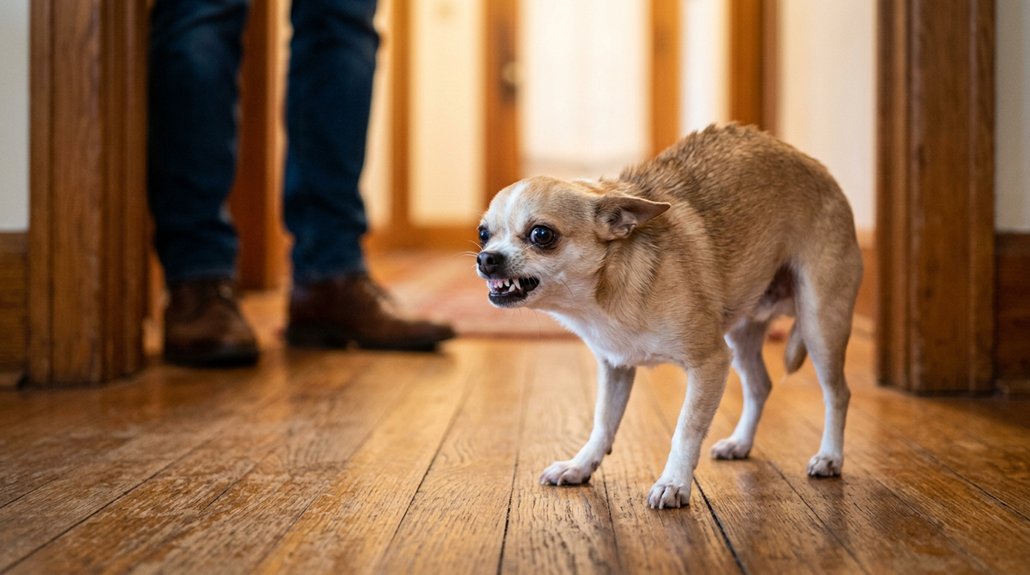
Picture your tiny dog planting its paws firmly, releasing a barrage of barks at every stranger who dares come near. It’s frustrating, and you’re probably wondering why your small dog acts like the neighborhood’s toughest security guard. The answer involves instinct, psychology, and — surprisingly — your own behavior. Keep going, because what you’ll discover might completely change how you handle this.
Why Small Dogs Feel More Threatened by Strangers Than Large Dogs Do
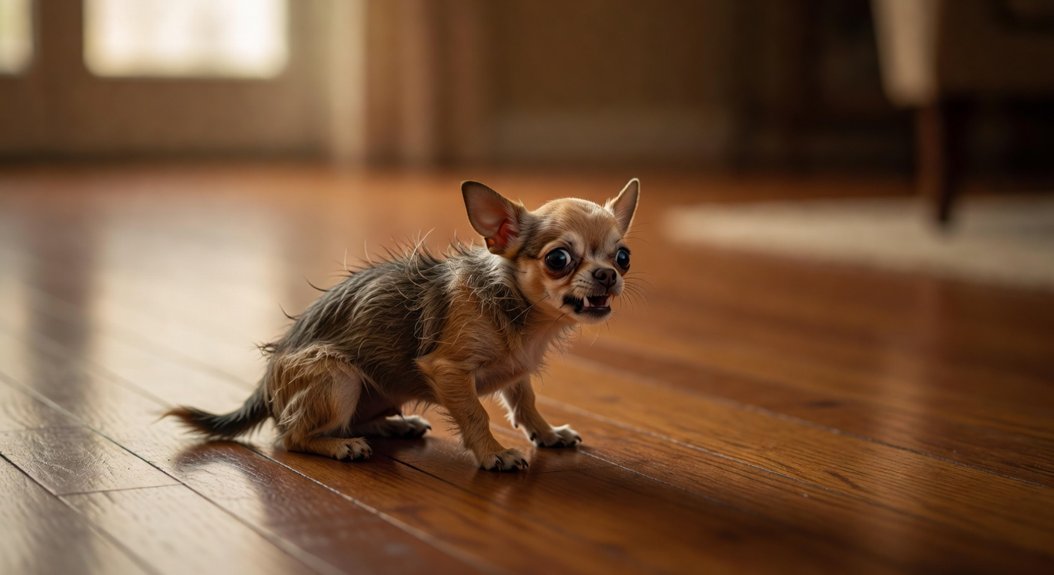
Small dogs aren’t just being dramatic when they bark at strangers—they’re responding to a very real size disadvantage. Think about it from your Chihuahua’s perspective: every unfamiliar human towering overhead looks like a skyscraper with legs. That’s genuinely terrifying.
Large dogs stand closer to human eye level, making strangers feel less physically overwhelming. Your Great Dane isn’t braver—he’s just not staring directly into someone’s kneecap.
Small dogs compensate for their lack of physical intimidation by going vocal. It’s their version of puffing up. Since they can’t realistically wrestle a stranger into submission, noise becomes their best defense strategy.
How Coddling Small Dogs Makes Stranger Barking Worse
When you scoop up your trembling Chihuahua and coo “it’s okay, sweetie” every time a stranger approaches, you’re actually telling him his fear is justified. Congratulations — you’ve accidentally trained your tiny tyrant to believe strangers are apocalyptic threats requiring immediate rescue.
Coddling reinforces barking because:
- You’ve rewarded panic — treats and cuddles after freaking out = “strangers equal jackpot”
- You’ve confirmed the danger — your anxious reaction validates his theatrical meltdown
- You’ve stolen his confidence — he never learns strangers aren’t actually assassins
- You’ve created a cycle — he barks, you coddle, he barks louder next Tuesday
Your dog needs calm leadership, not a standing ovation for his one-man horror show.
Breeds Most Prone to Excessive Barking at Strangers
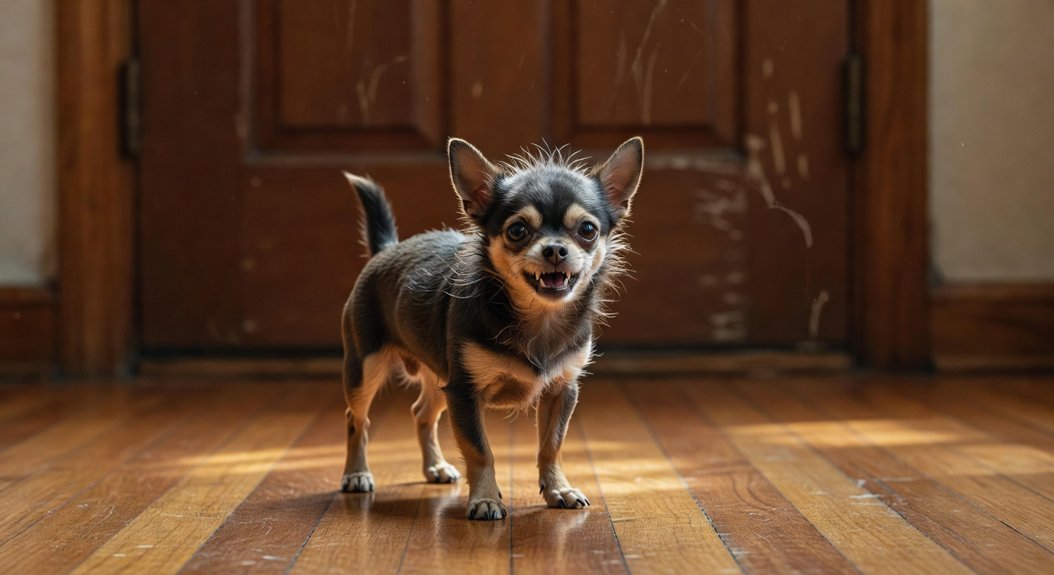
If you own a Chihuahua, you’ve likely noticed their intense alertness, which makes them quick to bark at any unfamiliar face. Dachshunds, bred originally to hunt, carry strong territorial instincts that cause them to vocalize loudly when strangers approach their space. Pomeranians are naturally vocal dogs, and their tendency to bark excessively at strangers is almost hardwired into their personality.
Chihuahuas And Their Alertness
Chihuahuas are one of the most alert and vocal breeds you’ll encounter, often reacting to strangers with an intensity that seems disproportionate to their tiny size. Think of them as security guards who’ve had too much espresso. Their alertness stems from deeply rooted instincts, making them surprisingly effective watchdogs despite weighing less than your laptop.
Here’s why your Chihuahua goes full alarm mode:
- They’re convinced every stranger is a legitimate threat to national security.
- Their tiny ears catch sounds you’ll never hear.
- They genuinely believe they’re 100 pounds of pure muscle.
- Centuries of selective breeding wired them for hypervigilance.
Understanding this helps you appreciate their barking instead of just covering your ears every time the mailman arrives.
Dachshunds’ Territorial Tendencies
Dachshunds carry two traits that practically guarantee a barking problem: a fierce territorial instinct and a hunting dog’s boldness that makes them utterly fearless about confronting strangers. Originally bred to chase badgers into underground tunnels, your Dachshund genuinely believes it’s still on duty. That mailman? Absolutely a badger. Your neighbor waving hello? Suspicious badger behavior. Don’t let the little sausage shape fool you — this dog’s convinced it’s a Rottweiler trapped in an elongated body. Their territorial nature means they’ll claim your entire home, yard, and honestly your car as protected zones requiring constant vocal defense. You’ll notice they’re loudest when they’re smallest, compensating for their stature with sheer bark volume. It’s equal parts hilarious and exhausting.
Pomeranians Vocal By Nature
Pomeranians are fundamentally tiny alarm systems wearing fur coats. Their vocal tendencies aren’t accidental — it’s literally bred into them. You’re not imagining things; your Pom genuinely believes it’s protecting you from catastrophic threats like:
- The mail carrier delivering your packages
- Your neighbor simply existing outdoors
- A suspicious leaf blowing past the window
- Your own reflection confusing absolutely everyone
Their ancient spitz heritage hardwired them for alerting humans to danger, except now “danger” means literally anything moving within a three-block radius. You’ll notice your Pomeranian doesn’t bark occasionally — it delivers full dramatic performances. Training helps considerably, but you’re practically negotiating with a tiny fluffy politician who’s already convinced they’re completely right.
Why Do Small Dogs Bark More Than Larger Dogs?

While it might seem like small dogs are just naturally noisier, there’s actually more going on beneath the surface. Think of it this way: your tiny Chihuahua is fundamentally a personal bodyguard trapped in a bite-sized body. Small dogs bark more because they’ve learned it’s their most effective defense mechanism. They can’t intimidate strangers with sheer size, so volume becomes their superpower.
There’s also something called “Napoleon Complex” in dogs — they overcompensate for their small stature with big personality and bigger noise. Furthermore, you’ve likely unintentionally reinforced the behavior by picking them up when they bark, effectively rewarding the drama. Their heightened anxiety around larger beings makes them perceive almost everything as a threat, turning your doorbell into a full-blown emergency broadcast system.
Fear or Territorial Barking: Which Does Your Small Dog Have?
Now that you understand why small dogs bark, the next step is figuring out what’s actually triggering yours — because fear barking and territorial barking look similar but require different approaches.
Fear barking signs:
1. Your dog retreats while barking, basically trash-talking from a safe distance
2. They tuck their tail like they’ve seen something absolutely unforgivable
Territorial barking signs:
3. Your dog plants their tiny feet and channels their inner security guard
4. They bark *louder* as the stranger approaches — zero retreat, maximum drama
The key difference? Fear barkers want distance; territorial barkers want confrontation. Knowing which one you’re dealing with saves you from accidentally reinforcing the wrong behavior and turning your Chihuahua into an even bigger neighborhood menace.
Signs Your Small Dog’s Barking Is Anxiety-Driven, Not Aggression
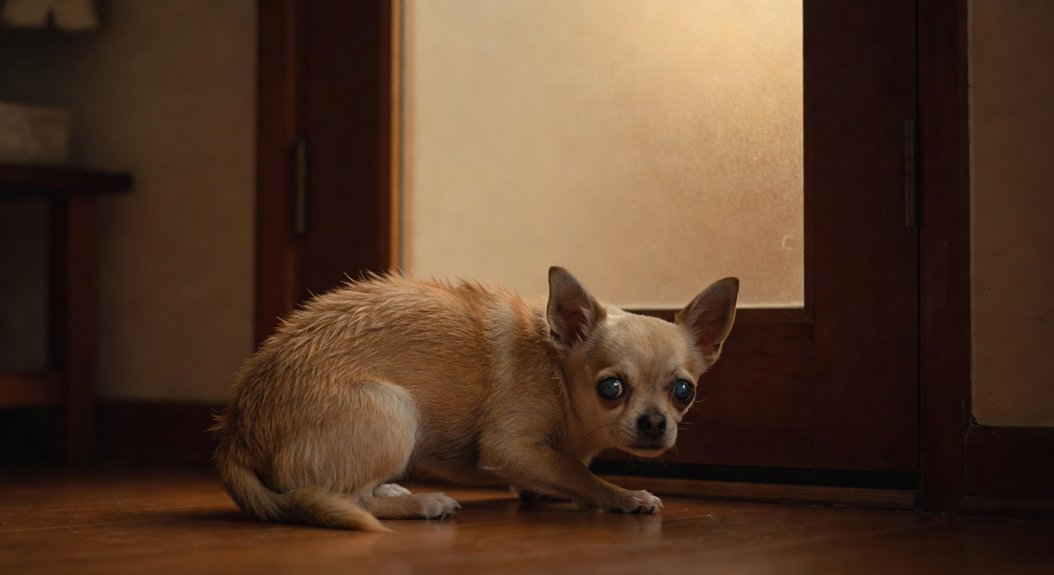
Anxiety-driven barking is easy to mistake for aggression, but the underlying emotion is completely different — and so is the fix. Your small dog isn’t trying to intimidate strangers; he’s basically screaming, *”I’m terrified and also four pounds, please help.”* Watch for these telltale signs: tucked tail, flattened ears, crouching body, or frantic retreat after barking. Aggressive dogs lean *forward*; anxious dogs lean *away* while still running their mouths. You might also notice yawning, lip-licking, or whale eye — that dramatic side-eye revealing way too much white. If your dog bolts behind your legs immediately after barking, that’s pure anxiety. Recognizing the difference matters enormously because training anxious dogs requires building confidence, not correcting “bad behavior.” You’re dealing with a scared little gremlin, not a villain.
How Early Socialization Shapes Your Small Dog’s Barking at Strangers
If your small dog didn’t get enough exposure to unfamiliar people during the critical socialization window—typically between 3 and 14 weeks of age—they’re far more likely to bark frantically at strangers as adults. During this window, positive experiences with diverse people, sounds, and environments wire your pup’s brain to accept novelty rather than fear it. You can still make progress after this period by using controlled stranger exposure techniques, like pairing calm greetings with high-value treats, to gradually reshape your dog’s response.
Critical Socialization Windows
Between 3 and 14 weeks of age, your small dog’s brain is forming the neural pathways that will define how it responds to strangers for the rest of its life. Miss this window, and you’ll have a tiny, furious alarm system on your hands.
During these weeks, exposure matters enormously:
- Meeting diverse humans prevents your dog from treating every visitor like an invading army
- Positive stranger interactions rewire fear responses before they calcify
- Varied environments build confidence that “new” doesn’t mean “terrifying”
- Gentle handling by strangers teaches that unknown hands aren’t weapons
Skip socialization, and you’re fundamentally programming a pint-sized panic machine. That critical window closes fast, so don’t waste it binge-watching Netflix while your puppy develops lifelong anxiety.
Stranger Exposure Techniques
Once that socialization window opens, how you introduce your small dog to strangers determines whether it grows up greeting people with curiosity or launching into a barking frenzy. Think of yourself as a tiny dog PR manager — your job’s convincing your pup that strangers aren’t villains in disguise.
Start by exposing your dog to different people in calm, controlled settings. Have strangers offer high-value treats, letting your dog approach on its own terms. Don’t force interactions; nothing backfires faster than a frightened Chihuahua deciding all humans are monsters.
Vary the strangers — different hats, beards, uniforms, and gaits. Your dog needs a broad “normal human” database. Consistent, positive exposures rewire its threat-detection system, replacing that hair-trigger alarm with something resembling actual social grace.
How Owners Accidentally Reinforce the Barking
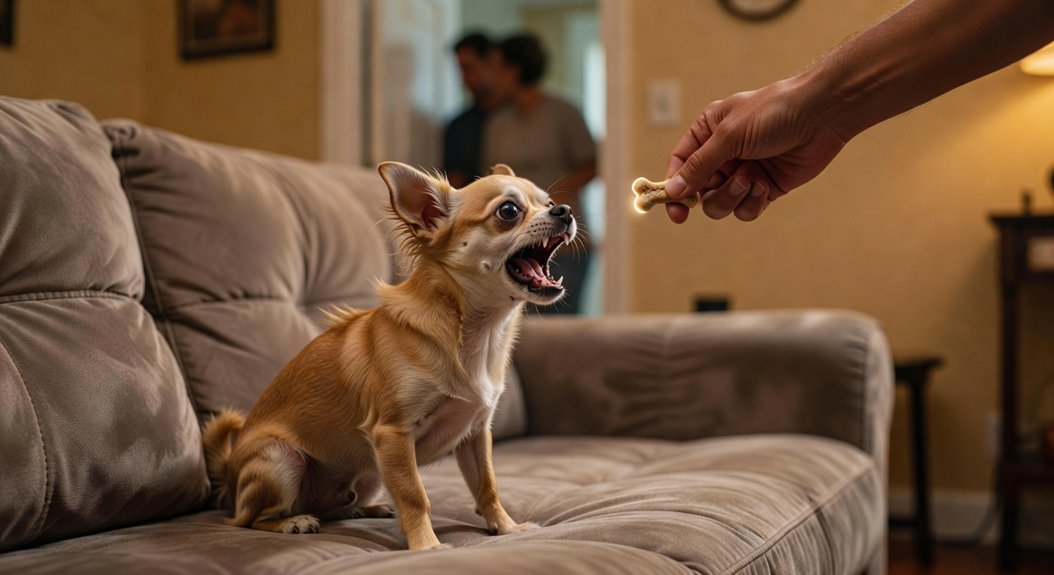
Many owners unknowingly make the barking worse by responding to it in ways that feel kind or logical in the moment. You’re basically running a rewards program for bad behavior without realizing it.
Here’s how you’re accidentally handing out gold stars:
- Picking them up when they bark at strangers tells them chaos = cuddles.
- Saying “it’s okay” soothingly confirms something *is* actually wrong.
- Laughing it off signals barking is entertaining and worth repeating.
- Removing them from the situation teaches avoidance instead of confidence.
You love your dog, but love isn’t strategy. Every time you rescue them from a perceived threat, you’re reinforcing the idea that strangers are genuinely terrifying — and they’ll never stop believing you.
Training Methods That Actually Stop Small Dogs Barking at Strangers
The good news is that small dogs respond just as well to proper training as large breeds — they just need you to stay consistent and stop treating every bark like a crisis.
Three techniques actually work:
| Method | What You Do | What Your Dog Learns |
|---|---|---|
| Desensitization | Gradually expose them to strangers | Strangers aren’t assassins |
| “Quiet” Command | Reward silence, not barking | Shutting up pays better |
| Controlled Greetings | Let strangers offer treats | New people equal good things |
Practice daily in short sessions. You’re fundamentally reprogramming a tiny drama machine that’s convinced it’s a Rottweiler. Stay calm, reward correct behavior immediately, and never comfort mid-bark — you’re reinforcing the chaos, not the dog.
The Bark-Reduction Tools Worth Using on Small Dogs
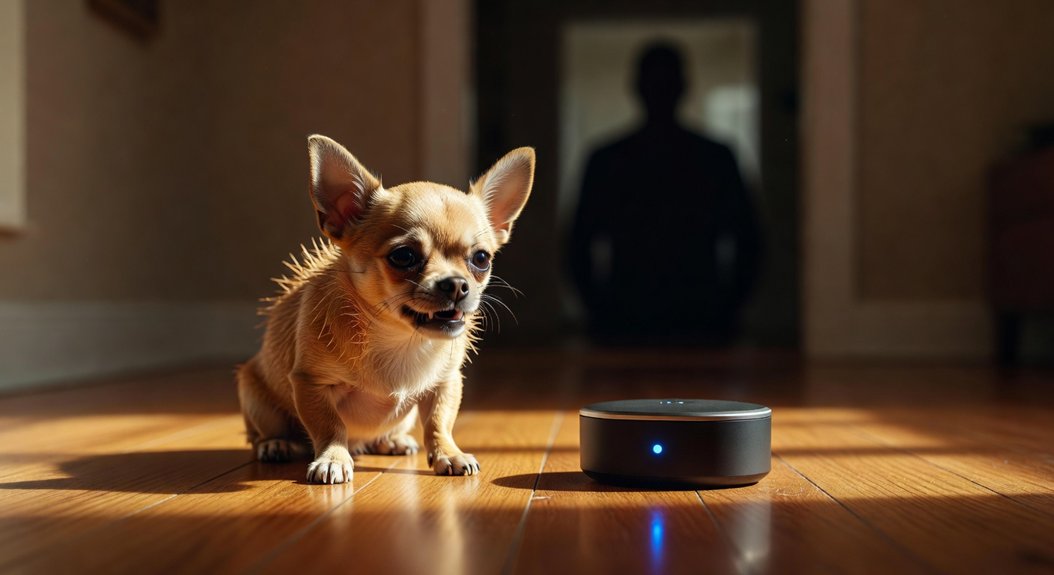
Training alone doesn’t always cut it, so bark-reduction tools can bridge the gap — but not all of them are appropriate for small dogs, whose physiology and temperament make certain devices more harmful than helpful.
Not every bark-reduction tool suits small dogs — their unique physiology and temperament make some devices more harmful than helpful.
Here’s what actually works without traumatizing your tiny drama queen:
- Ultrasonic bark deterrents — emit a high-pitched tone only dogs hear, interrupting barking without shock or discomfort
- Citronella spray collars — release a harmless spritz that distracts mid-bark, because apparently smelling like a candle is deeply offensive
- Vibration collars — gentle buzz signals without electric shock, keeping small necks safe
- White noise machines — reduces stranger-triggered anxiety by masking outside sounds before barking even starts
Choose tools reinforcing calm behavior, not fear.
The Best Age to Start Training a Small Dog to Stop Barking
Puppies as young as seven to eight weeks old can begin learning basic bark-control cues — and the earlier you start, the easier it is to shape habits before they calcify into full-blown reactive behavior. Think of it like catching a bad habit before it gets a Netflix special and a devoted fan base.
That said, if you’ve adopted an older dog, don’t panic. Dogs of any age can learn, though it takes more patience and consistency. A two-year-old Chihuahua who’s been barking at mail carriers like they’re war criminals isn’t a lost cause — they’re just a project. Start wherever you are, stay consistent, and you’ll still see meaningful progress regardless of your dog’s age.