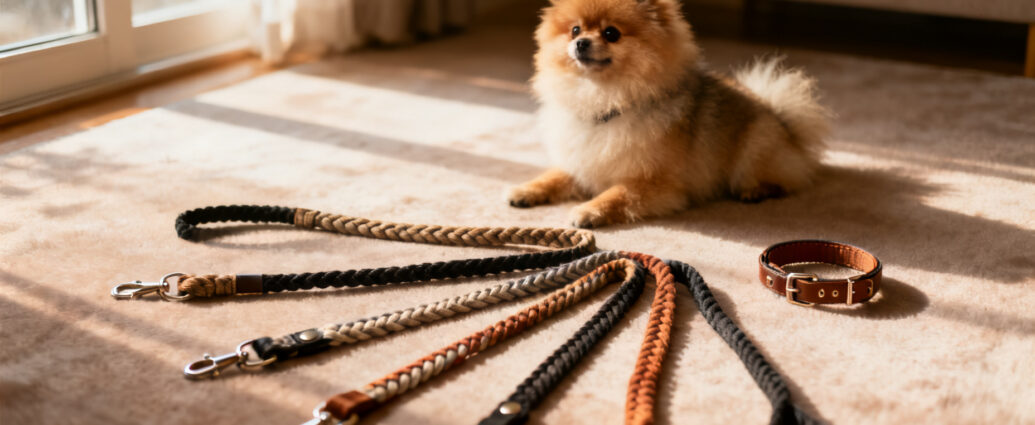
Why Leash Length Actually Matters for Pomeranian Puppies (More Than You’d Think)
Your Pomeranian puppy weighs about three to seven pounds. That’s lighter than a bag of flour you’d buy at the store!
The wrong leash isn’t just annoying – it can actually hurt your puppy. When there’s too much extra leash dragging around, you both might trip over it. But a leash that’s too short? That’s even worse. One quick pull can hurt their tiny neck and windpipe. Pomeranians already have weak windpipes, and rough tugging when they’re babies can make problems show up when they’re older.
Different things you do with your puppy need different amounts of space:
• Walking nicely beside you needs close control
• Teaching them to come when called needs more distance
• Letting them sniff around needs room to explore
One leash can’t do everything, no matter how many good reviews it has online.
You need a few different leashes for different situations. Not a whole messy drawer full of them – just a smart set of leashes that each do their own job.
The 4-Foot Leash: Your Crowded-Space and Early Training Anchor
This is the leash you grab for the vet. For busy sidewalks. For the pet store.
It keeps your Pom puppy right next to you without extra leash that can wrap around your legs – or their legs, which happens a lot when you’ve got a five-pound furball who hasn’t figured out where their own feet are yet. Picture a puppy in downtown Phoenix during First Friday – tons of people, food trucks, noise everywhere. When your puppy still wants to chase every leaf and every bird, this short leash helps you stop trouble before it starts.
Get a lightweight one made of nylon or biothane that’s 3/8-inch wide. Anything fatter is too heavy for a Pomeranian puppy. They should barely feel it.
Don’t use this length when your puppy needs space to explore or practice coming to you from far away. This is your “stay close” leash, not your “go have fun” leash. It’s the leash that says “the world is really busy right now, so stick with me.”
The 6-Foot Leash: Your Daily Walk Workhorse
This one is just right.
Once your Pom knows basic leash manners, this gives them enough room to sniff things and pick where they want to walk. But you still have enough leash to guide them away when they spot something they shouldn’t have. It’s perfect for teaching them to walk without pulling – you can give them more leash or take some back without constantly pulling them around.
What to look for: A padded handle so your hand doesn’t hurt, because you’ll use this leash once or twice every single day for the next ten years. Get one with reflective stitching for walks when it gets dark. Make sure the clip is brass or stainless steel for small dogs – the cheap clips break at the absolute worst times, like when a big dog comes running up.
This is the leash that should hang by your front door. It’ll get used more than any other. Spend good money here. Imagine buying one really good six-foot leash for forty dollars that lasts for years, versus buying three cheap fifteen-dollar leashes that break and feel uncomfortable every time you hold them.
The 15-Foot Long Line: Controlled Freedom for Sniff Walks and Early Recall
Special sniff walks at parks or quiet fields are when this leash is perfect. Your Pom can follow interesting smells without you standing right on top of them, watching their every move. Dogs learn about the world through their noses way more than we do. This leash lets them actually be a dog.
It’s also really good for teaching them to come when you call. They’re far enough away that it’s real practice, but close enough that you can still catch them if they decide that smell over there is way more interesting than listening to you.
Get a lightweight long line – NOT the kind that rolls up – made of biothane or coated nylon that won’t get all muddy and gross. Don’t get the rope kind that’ll hurt your hands if your puppy suddenly runs. Biothane costs more, but it’s worth it. You can wipe it clean, it doesn’t start smelling bad, and it stays bendy even when it’s cold outside (which matters here in Arizona during those few chilly winter mornings).
Important tip: Let it drag on the ground or hold it really loosely. Don’t keep it tight. The whole point is to let your puppy feel like they’re free while you still have a safety rope attached, not to control them from farther away.
The 20-Foot and 30-Foot Long Lines: Advanced Recall and Supervised Exploration
These are for serious practice teaching your puppy to come when called in safe areas. They’re for letting your Pom puppy get a taste of running free before they’re actually good at listening.
Twenty feet is easier for most people to handle without getting all tangled up. Thirty feet is for really big open spaces where you want them to roam far – imagine a Pomeranian puppy exploring a quiet desert trail or empty field with you way back there as a safety backup, ready if they need you but not breathing down their neck.
Only buy super lightweight ones. A heavy long line is pointless for a four-pound puppy who’ll just drag it around instead of running. Look for long lines that actually say they’re for small breeds or puppies. The ones made for big dogs like Labradors will tire out your tiny Pom before they even get started.
These are special tools, not everyday leashes. Use them for real training time, not quick potty breaks where you’ll just trip over thirty feet of leash on your apartment stairs.
What About Retractable Leashes? (The Honest Take)
Some people love retractable leashes, but honestly? They’re pretty risky for Pomeranian puppies.
The skinny cord can give rope burns on their soft skin if it wraps around a leg. The big plastic handle is hard to grab when something scary happens – imagine trying to hold it right when your puppy sees a huge dog and you need to pull them back immediately. Plus, the leash never really goes loose like a normal leash does, so it actually teaches your puppy to pull all the time.
There’s really only one time they make sense: if you live in an apartment or condo where you need different leash lengths for narrow hallways versus the grass outside, and you’re super careful about locking it at different lengths in different places.
If you do get one, pick one made for small dogs under ten pounds. Get the flat ribbon kind instead of the thin cord – it’s gentler if it touches their skin. And never let it go all the way out near cars or other dogs. The lock button can break, and that tiny delay in stopping your puppy could mean the difference between safe and hurt.
Building Your Pomeranian Puppy Leash Rotation (What to Buy First)
Start with a six-foot leash for daily walks and a fifteen-foot long line for weekend training. These two will cover almost everything you need for the first six months.
Buy the four-foot leash later, once your puppy starts going to busier places regularly – usually around four to five months old, when you’re taking them more places with crowds and tight spaces.
The twenty-foot or thirty-foot long line comes last, for serious work teaching them to come when called from far away. You don’t really need it until your Pom is six months or older and ready to learn off-leash skills. Most puppies aren’t ready in their brains for that kind of training before then anyway.
Total cost for good leashes: Picture spending sixty to ninety dollars for quality leashes that’ll last for years and years versus replacing cheap ones every few months when the clip breaks or the stitching comes apart. Your Pomeranian will be with you for twelve to sixteen years. That’s a no-brainer.