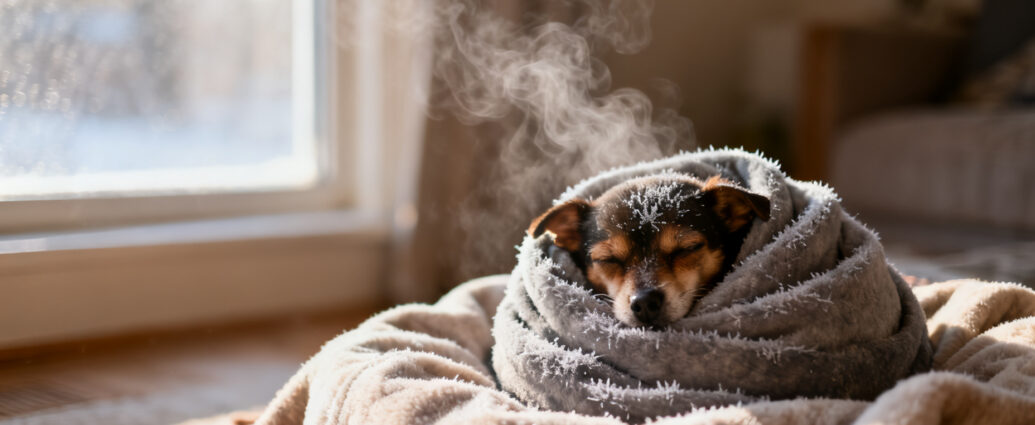
Science, frankly, has never done a small dog any favors when it comes to thermoregulation.
Here’s the brutal math: a five-pound Chihuahua carries a disproportionately enormous amount of skin relative to its body mass compared to, say, a fifty-pound Labrador. Heat bleeds off that surface area relentlessly. Think of a single ice cube sitting on a countertop next to a solid block – the cube vanishes first, every time. Your little Chihuahua? Essentially a warm ice cube parked in a drafty living room. Shivering is the body’s emergency furnace – skeletal muscles firing in rapid, involuntary bursts to generate heat when passive insulation falls short.
And some breeds drew an even shorter straw. Chihuahuas and Min Pins walk around with a single coat layer – no plush undercoat hiding beneath, no secret thermal blanket. What you see is genuinely all they’ve got. Meanwhile, Pomeranians and Westies sport a dense, hidden underlayer that traps warm air flush against the skin like a down jacket worn underneath a windbreaker. That structural difference alone can shift cold tolerance by ten to fifteen degrees. A Pomeranian might trot around contentedly at 50°F while a Chihuahua is already trembling at 65°F. Same species. Wildly different engineering.
Then there’s excitement shivering, and it has nothing whatsoever to do with temperature. You know exactly what this looks like – your Yorkie spots the leash and detonates into a full-body vibration like a phone on a glass table. That’s pure adrenaline dump. Small dogs run scorching-hot metabolisms paired with outsized neurological reactions to stimuli that excite them. All that chemical energy needs a physical outlet, and trembling is what happens. It’s completely harmless, entirely normal, and people unfamiliar with the dog almost always misread it as fear.
Aging reshapes the picture, too. A twelve-year-old Pomeranian has lost muscle density, and muscle is a furnace. The same dog that barrel-rolled through snow drifts at age three now genuinely needs a fleece sweater indoors at age twelve. Older dogs produce less metabolic heat and retain what they do produce far less efficiently. If your senior small dog has recently started shivering when they never did before, they aren’t being theatrical – their thermostat has legitimately shifted. They really are colder than they used to be.
When Cold Is Just Cold: Simple Temperature Guidelines
Here’s a handy guide for when your small dog needs extra warmth:
| Temperature | What Your Small Dog Needs |
|---|---|
| Below 45°F | A coat or sweater layer |
| Below 32°F | Serious insulation – thick coat, boots, limited time outside |
| 55°F – 65°F | Short-haired breeds like Chihuahuas may already need a layer |
| 40°F – 50°F | Double-coated breeds like Pomeranians are usually still okay |
These aren’t polite suggestions – these are the thermal thresholds where a small dog’s body starts losing its fight against ambient cold in measurable, physiological terms.
Picture a Pomeranian in full winter coat, perfectly unbothered at 40°F, tail curled over its back like nothing’s happening. Now picture a short-haired Chihuahua already vibrating at 55°F, looking at you like you’ve personally betrayed it. Both responses are completely normal. The Pom carries built-in insulation engineered over centuries of selective breeding; the Chihuahua simply doesn’t.
How to tell “just cold” shivering from something serious: Cold shivering resolves within five to ten minutes once the dog warms up. No other symptoms surface. The dog snaps right back to its usual self. If you bring your pup inside from a brisk walk and the shaking evaporates the moment they hit a warm bed, that’s cold – nothing more. If the shivering persists, or arrives alongside lethargy, vomiting, or behavioral changes that feel off, you’re looking at a different conversation entirely.
One thing that blindsides a surprising number of pet parents is indoor cold spots. Tile floors in winter can run fifteen degrees colder than the ambient air three feet above them. Air conditioning vents blast directly onto dog beds that got positioned there during summer and never relocated. Your small dog gravitates to the sunny patch on the hardwood even when you feel perfectly comfortable because their diminutive body demands more thermal input than yours to reach the same baseline of comfort.
Quick Fixes That Actually Help:
– Fleece-lined beds with raised sides to block drafts
– Sweaters with real insulation – not just cute fashion knits that don’t do anything
– Heating pads made specifically for pets, with auto-shutoff and chew-proof cordsThese aren’t spoiling your dog. They’re smart solutions for animals whose small size makes staying warm genuinely harder.
The Medical Red Flags: 3 Types of Shivering That Need a Vet
1. Pain-Related Trembling
Pain shivering announces itself differently than cold shivering. It tends to localize – one leg, the spine, around the jaw. The dog resists movement, yelps or flinches when touched, or holds its body rigid and braced. Common culprits in small breeds include:
- Luxating patellas – kneecaps that slip sideways out of their groove
- Dental pain from overcrowded teeth crammed into a jaw that’s simply too small
- Back injuries from launching off furniture that towers over them relative to their body size
It often creeps in quietly. A subtle tremor in one hind leg. A new reluctance at the bottom of the stairs. Then, over weeks or months, it escalates.
2. Hypoglycemia (Low Blood Sugar)
This one is a genuine emergency for dogs under five pounds. Tiny bodies store almost no glycogen reserve, and toy breeds can crash with terrifying speed. Alongside shivering, watch for weakness, disorientation, pale gums, or seizures. Missing a single meal can trigger a crisis in a four-pound dog – a scenario that would barely register in a forty-pound dog’s metabolism. Their furnace burns fuel at a blistering rate, and when the tank hits empty, systems start failing fast.
3. Neurological Tremors
These look fundamentally different from ordinary shivering. The shaking is rhythmic, almost mechanical – it doesn’t stop when the dog warms up, and it’s often markedly more intense. Toxin exposure can trigger this. Xylitol, chocolate (even laughably small amounts are dangerous for small dogs), and certain household plants rank among the most common culprits.
There’s also something called “white dog shaker syndrome,” which disproportionately affects Westies and Maltese. Veterinary science still hasn’t fully cracked why it happens, but the condition produces full-body tremors, typically emerging in young adult dogs of these breeds. Steroid therapy can manage it effectively, but it demands a proper diagnosis first – guessing won’t cut it.
Anxiety and Fear Shaking: The Emotional Side
Stress shivering arrives tethered to specific triggers. Thunderstorms. Fireworks. The parking lot of the veterinary clinic. It typically travels with a whole entourage of nervous signals – panting, pacing, hiding, ears plastered flat, those wide, glassy “whale eyes.” This shaking has zero connection to temperature. It’s about stress hormones flooding a tiny body that has no constructive outlet for the resulting surge of energy.
Small dogs are disproportionately prone to anxiety-driven trembling, and the reasons split between biology and biography. Insufficient socialization during the critical puppy window leaves permanent imprints on the nervous system. Being handled roughly – or dropped even once – can install fear that never fully uninstalls. And then there’s what some folks bluntly call the “purse dog” problem: dogs who spend the majority of their waking hours carried against someone’s chest simply never accumulate enough ground-level experience. The world down at floor height – unpredictable shoes, sudden movements, looming strangers – becomes genuinely terrifying when you’ve barely practiced navigating it.
What Can Help:
– A Thundershirt provides gentle pressure that calms the nervous system
– Desensitization training – slowly getting the dog used to scary things at low levels – builds tolerance over time
– For some dogs, anxiety medication is the kindest choice
Here’s my honest take: if your dog spends every storm season in abject, trembling terror despite every environmental intervention you’ve thrown at the problem, medication isn’t surrender. It’s acknowledging that their brain chemistry requires support that blankets and white noise machines cannot provide. Be realistic about outcomes. Management reduces anxiety – it rarely erases it. Medication can close more of that gap, but it needs veterinary guidance and sometimes a frustrating stretch of trial and error before you land on the right protocol.
Breed-Specific Shivering Patterns Worth Knowing
Chihuahuas and Min Pins are the poster children of seemingly inexplicable shivering, even in rooms that feel perfectly temperate to you. Their metabolisms run hot – they’re alert, reactive, wired for vigilance – but their cold tolerance bottoms out shockingly early. Plenty of owners stumble onto the 68°F indoor rule only after watching their dog shiver on the couch in a climate-controlled house and thinking something must be medically wrong. It’s not an act. It’s not drama. Their body genuinely hemorrhages heat faster than it can manufacture it.
Italian Greyhounds and Chinese Cresteds occupy the extreme end of the cold-sensitivity spectrum. These breeds honestly require indoor heating accommodations that catch most first-time owners completely off guard. Imagine keeping your thermostat pinned at 72°F and watching your Chinese Crested still patrol the house hunting for heating vents, burrowing under every available blanket like a creature preparing for arctic survival. That’s entirely normal for them. Their body architecture – razor-thin skin, negligible body fat, minimal or nonexistent coat – makes them thermal outliers even within the small-dog universe.
Pomeranians and Yorkies are far less likely to shiver from cold but dramatically more likely to shake from sheer emotional overload. A Yorkie greeting a visitor vibrates with undiluted joy. A Pomeranian watching dinner preparations quivers with almost unbearable anticipation. Grooming decisions matter enormously here – a Pomeranian in full, uncut coat carries legitimate insulation, but that same dog fresh from a summer trim loses that protection entirely. The thermal difference between “full coat” and “groomed short” is staggering.
Westies and Cairn Terriers carry a breed-specific vulnerability: white dog shaker syndrome. It typically surfaces during young adulthood – somewhere between one and three years old. Why this particular cluster of breeds developed its own neurological condition remains incompletely understood, but the clinical pattern is well-documented. If your young Westie develops persistent whole-body tremors that don’t resolve with warming, this condition absolutely belongs on the differential diagnosis.
What to Tell Your Vet (And When to Actually Go)
These questions matter before you pick up the phone:
- Is the shivering constant, or does it surface only in specific situations?
- Does warming up resolve it?
- Are there accompanying symptoms – vomiting, lethargy, appetite loss, behavioral shifts?
- How long has this been going on – days, weeks, suddenly since this morning?
Go to the vet the same day if you see:
– Shivering plus weakness or collapsing
– Shivering after your dog may have eaten something toxic
– Shivering with pale gums or trouble breathing
– Sudden shivering in a dog who never shivers
These combinations can signal serious underlying problems – hypoglycemia, poisoning, a pain emergency, or acute illness that’s escalating.
It can wait a few days if you see:
– New shivering in cold weather with no other symptoms
– Shivering that stops completely once the dog warms up
– Excitement shivering that’s become more pronounced but carries no signs of distress
These patterns point toward environmental or behavioral causes that aren’t emergencies – but they’re still absolutely worth raising at the next scheduled vet visit.
📱 Pro tip: Record video of everything before the appointment. Film the shivering itself, any triggers you’ve identified, and how your dog moves and behaves between episodes. The symptom almost never cooperates in the exam room – either the dog is too stressed and shuts down entirely, or the adrenaline of a new environment masks the very thing you came to discuss. Your vet needs to see what you see at home. Thirty seconds of shaky phone footage is worth more than ten minutes of verbal description.
The Practical Shivering-Prevention Kit
Sweaters that actually keep dogs warm feature fleece lining, chest coverage extending past the ribcage, and a cut proportioned to your dog’s actual body shape. Barrel-chested breeds like French Bulldogs demand completely different dimensions than whippet-thin breeds like Italian Greyhounds. A sweater that fits a Chihuahua won’t fit a Yorkie of identical weight – their torso geometry is just too different. Imagine a pet parent standing in the store, cycling through three different sweaters before finding one that doesn’t immediately spin sideways on their wiggly little Italian Greyhound – that’s a pretty universal experience among small-dog owners.
Indoor comfort adjustments to make:
- Heated pet beds with chew-proof cords
- Thermal crate pads for nighttime that maintain warmth without overheating risk
- Smart bed placement – away from drafts, off cold floors, out of the direct path of AC vents
None of these fixes are expensive. They just require a few minutes of intentional thought.
The emergency hypoglycemia kit for toy breed owners: Keep a small syringe of corn syrup or honey in your supplies at all times. For a four-pound dog in crisis, a small amount rubbed directly on the gums can buy you precious minutes to reach the vet. It’s not a cure – it’s a bridge. If your dog is weak, disoriented, or shivering from plummeting blood sugar, they need professional intervention. But corn syrup can keep them conscious and responsive long enough to get there. Know the difference between buying time and solving the problem – and always, without exception, follow up with veterinary care.